Reviewed ans Updated: July 3, 2026
A dirty office can become a daily source of frustration long before anyone makes a formal complaint. Overflowing trash, sticky breakroom counters, poorly maintained restrooms, dusty vents, stained carpets, and neglected meeting rooms can make employees feel uncomfortable in the place where they spend much of their week. These issues may seem small on their own, but together they can distract employees, interrupt routines, and make the workplace feel less professional.
Office cleanliness will not determine employee retention on its own. Pay, leadership, workload, benefits, flexibility, growth opportunities, and workplace culture all matter. Still, a clean, well-maintained office is one visible part of the employee experience that a business can control. For New Jersey employers, a consistent office cleaning plan can help maintain a more comfortable environment for employees while also protecting the impression made on clients, candidates, vendors, and visitors.
Quick Answer: Can a Dirty Office Reduce Productivity and Affect Retention?
Yes, a dirty office can reduce productivity by creating distractions, discomfort, cluttered shared areas, unpleasant odors, and extra tasks that employees must handle during the workday. It can also affect employee satisfaction because the condition of restrooms, breakrooms, floors, and common spaces sends a message about workplace standards. However, office cleanliness should be viewed as one part of employee retention, not the only cause of turnover.
A peer-reviewed study of five nonprofit office environments in the Netherlands found that higher measured cleanliness was significantly associated with higher perceived productivity and work satisfaction. The study shows a relationship, not proof that cleaning alone causes better output or retention, but it supports the idea that workplace conditions can influence how employees feel about their work environment.
- Dirty shared spaces can interrupt focus and routines.
- Poor restroom conditions can reduce employee comfort.
- Unclean breakrooms can create frustration during breaks.
- Dusty, cluttered meeting rooms can delay meetings or client visits.
- Dirty reception areas can hurt first impressions.
- Employees may feel overlooked if common spaces are repeatedly neglected.
- Inconsistent cleaning can shift avoidable cleaning work onto employees.
| Office Issue | Employee Impact | Business Impact |
| Overflowing trash | Creates frustration and unpleasant odors | Makes the workplace look neglected |
| Dirty restrooms | Reduces comfort and hygiene confidence | Can lead to employee complaints |
| Messy breakroom | Interrupts breaks and shared routines | Lowers the standard of common areas |
| Stained floors or carpets | Makes the office feel poorly maintained | Hurts visitor impressions |
| Dirty shared equipment | Adds friction during daily tasks | Makes operations feel disorganized |
| Dusty reception area | Creates a poor first impression | Can affect client and candidate perception |
What Counts as a Dirty or Poorly Maintained Office?
A dirty office is more than a dusty desk or a full trash bin. It can include cluttered shared spaces, neglected restrooms, dirty kitchen appliances, stained carpets, dusty blinds, fingerprints on glass, food residue in breakrooms, poor floor care, and inconsistent cleaning of high-touch areas. The issue is often not one major mess. It is the repeated buildup of small problems that employees see every day.
Visual Clutter and Neglected Shared Spaces
Visual clutter can include stacked boxes in hallways, crowded supply rooms, messy meeting tables, full mail stations, scattered breakroom items, dirty reception desks, and overflowing waste bins. These issues make common spaces harder to use and can affect how organized the workplace feels. Employees should be able to enter a conference room, use a printer, take a lunch break, or meet with a client without first having to clear someone else’s mess.
Common office clutter zones include:
- Reception desks and waiting areas
- Conference-room tables
- Shared printers and copier stations
- Mail and package areas
- Supply closets
- Breakroom counters
- Coffee stations
- Shared workstations
- Hallways and entryways
Hygiene, Sanitation, and Maintenance Are Different Tasks
Routine office cleaning removes dust, dirt, crumbs, spills, and visible grime. Sanitising and disinfecting are separate processes with different purposes, and HVAC maintenance is a separate responsibility again. The CDC recommends cleaning high-touch surfaces regularly and cleaning other surfaces when visibly dirty; disinfection is generally recommended after a known illness or in situations where it is otherwise appropriate. A business should avoid treating every issue as a disinfecting problem. A sticky counter, dusty floor, dirty microwave, or stained carpet usually needs proper cleaning first. For disinfectants to work as intended, follow product labels, including the required contact time, which keeps the surface wet long enough for the product to work.
How Dirty Offices Create Daily Productivity Friction
Productivity problems often begin with small interruptions rather than one major issue. Employees may spend time cleaning a conference table before a meeting, searching for a usable seat in the break room, handling overflowing trash, finding restroom supplies, or working around cluttered shared equipment. These repeated interruptions can make the workday feel less efficient and less comfortable.
Cluttered Shared Areas Interrupt Focus
Shared areas are meant to support work, but clutter can make them difficult to use. A meeting room with cups, papers, dirty tables, smudged glass, or full trash bins may force employees to clean before a client call or team discussion. A crowded printer station can slow routine tasks. A messy supply room can make it harder to find basic materials.
Office managers should pay close attention to:
- Conference-room tables and chairs
- Whiteboards and presentation screens
- Shared keyboards and desk stations
- Printers, copiers, and control panels
- Mailrooms and package areas
- Reception counters
- Storage shelves and supply closets
Poor Restroom and Breakroom Conditions Waste Time
Restrooms and breakrooms are used throughout the day by multiple people. If a restroom has odors, dirty fixtures, empty soap dispensers, full trash bins, or missing paper supplies, employees notice immediately. If a breakroom has food spills, sticky counters, dirty microwaves, or an unclean sink, employees may avoid using it or spend their own time cleaning it. OSHA requires employers to maintain workplace restrooms in a sanitary condition and provide running water, soap or similar cleansing agents, and drying facilities such as towels or air blowers.
Dirty Floors, Entryways, and Carpets Affect Comfort
Floors and entryways set the tone for the workplace because employees and visitors see them first. Tracked-in dirt, stained carpets, dull hard floors, dusty baseboards, and neglected entry mats can make the whole office appear poorly maintained. In New Jersey, wet weather, snow, salt, rain, and busy foot traffic can make floor care especially important during certain parts of the year. A routine plan should include vacuuming, mopping, spot cleaning, entry-mat care, and periodic floor detailing based on traffic levels. RMS Cleaning offers commercial floor cleaning for New Jersey offices and other business properties that need support beyond basic vacuuming and mopping
How Dirty Offices Affect Employee Morale and Retention
Employee retention depends on many factors, but a neglected office can add to dissatisfaction. Employees may interpret dirty restrooms, unclean breakrooms, full trash bins, and dusty common areas as signs that their comfort is not a priority. A clean office does not replace good leadership or fair compensation, but it can support a workplace that feels more respectful and better managed.
Workplace Cleanliness Signals Company Standards
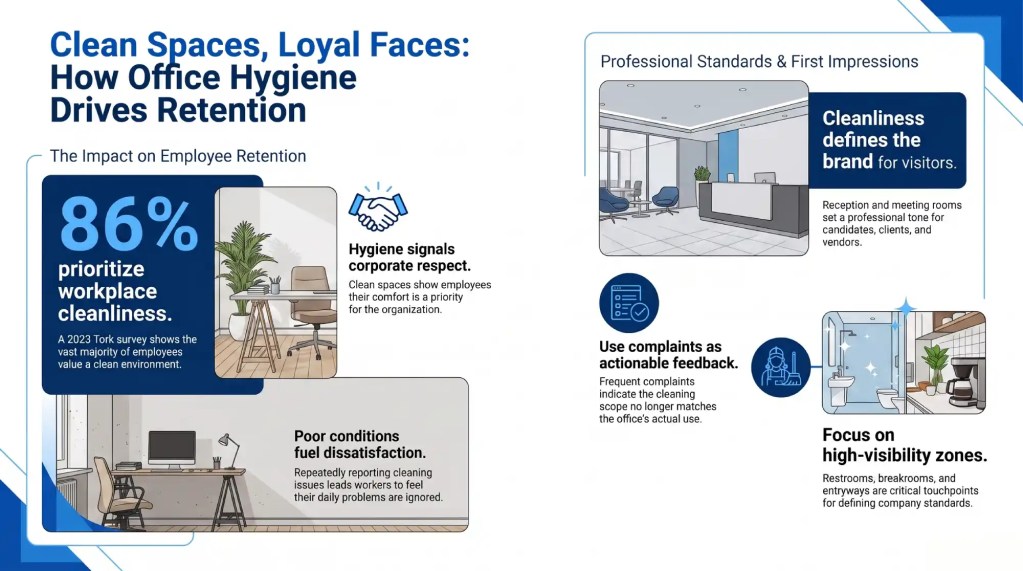
The condition of a workplace often communicates standards without anyone saying a word. Clean restrooms, stocked supplies, tidy meeting rooms, fresh breakrooms, and maintained floors can show that the company pays attention to basic daily needs. In contrast, recurring cleaning problems may lead employees to question why small issues are left unresolved. A 2023 Tork survey reported that 86% of surveyed office employees considered cleanliness important in their work environment. The result should be treated as survey data rather than universal proof, but it supports the practical point that employees do notice workplace cleanliness.
Poor Conditions Can Add to Employee Dissatisfaction
A dirty office is rarely the single reason an employee leaves a company. Yet it can become part of a wider negative experience, especially if employees feel they must clean common spaces themselves or repeatedly report the same issues without improvement. Dirty kitchens, bathrooms, shared desks, and meeting rooms can make workers feel that daily problems are being ignored. Businesses should treat repeat cleaning complaints as useful feedback. If employees mention odors, dirty floors, full bins, dusty desks, or restroom problems often, the current cleaning frequency or service scope may not match the office’s actual use.
A Clean Office Supports Better First Impressions
Office cleanliness also affects visitors. Candidates attending interviews, clients arriving for meetings, vendors delivering supplies, and new employees on their first day may all see the reception area, restrooms, break rooms, meeting rooms, and entryways. A clean office can support a stronger professional impression before the meeting even begins. For customer-facing businesses, reception glass, lobby floors, seating areas, restroom condition, and conference rooms should receive regular attention. These spaces show whether the business is prepared, organised, and respectful of the people entering the building.
Cleaning, Disinfecting, and Air Quality Need Different Solutions
A strong office-maintenance plan recognises that cleaning, disinfecting, and ventilation are related but separate tasks. Cleaning companies can manage visible dirt, dust, debris, floors, restrooms, breakrooms, and high-touch surfaces. Building owners or qualified HVAC professionals should handle ventilation systems, filtration upgrades, and mechanical issues.
Cleaning and Disinfecting Are Not the Same Service
Cleaning removes dirt, grease, dust, food residue, and other material from surfaces. Disinfecting uses an appropriate product to kill certain germs after cleaning. The CDC states that regular cleaning is usually enough in many facilities, while additional disinfection may be useful after someone has been ill or in certain high-traffic situations.
For office managers, this means the first priority is a reliable cleaning schedule. High-touch areas such as door handles, light switches, shared desks, elevator buttons, printers, phones, and restroom fixtures should receive regular cleaning attention. If disinfection is required, products should be used exactly as directed on the label.
Office Cleaning Does Not Replace HVAC Maintenance
Dusting vent covers and removing visible dust can improve the appearance of an office, but it does not replace HVAC servicing, filter replacement, ventilation assessment, or air-cleaning improvements. NIOSH identifies filtration and germicidal ultraviolet air treatment as primary methods for improving workplace air cleanliness, while ventilation improvements may require input from qualified HVAC professionals. If employees report stale air, temperature issues, visible dust around vents, persistent odours, or concerns about ventilation, the building manager should assess the HVAC system separately from routine office cleaning.
Restroom Standards Need Ongoing Attention
Restrooms cannot be treated as a once-a-week task in a busy office. Soap dispensers, paper supplies, trash bins, sinks, mirrors, floors, toilets, and odours need attention based on usage. A restroom that is clean at 8 a.m. may need another check before the workday ends. A practical restroom plan should include regular fixture cleaning, trash removal, supply restocking, floor care, odour checks, and prompt reporting of plumbing or maintenance issues.
Build an Office Cleaning Schedule Based on Traffic and Usage
The right cleaning frequency depends on office size, employee count, visitor traffic, restroom use, breakroom activity, floor type, shared equipment, business hours, and whether the workplace receives customers or job candidates. A small office with limited daily traffic may need a different plan from a busy corporate workspace, medical office, retail back office, or shared office environment.
Daily Tasks for High-Traffic Office Areas
Daily tasks usually focus on the spaces employees use repeatedly. These areas tend to affect comfort and first impressions most quickly.
- Restroom cleaning and supply checks
- Breakroom counter and sink cleaning
- Trash and recycling removal
- Reception and entryway upkeep
- High-touch surface cleaning
- Shared-equipment wipe-downs
- Conference-room resets
- Floor spot cleaning
Weekly and Periodic Detail Cleaning
Weekly and periodic cleaning targets the areas that collect dust and buildup slowly. These details may not need daily work, but ignoring them for too long can make the office look neglected.
- Vacuuming carpets
- Mopping hard floors
- Cleaning blinds and windowsills
- Dusting vents and ceiling fixtures
- Baseboard cleaning
- Carpet spot treatment
- Deep breakroom cleaning
- Detailed restroom cleaning
- Floor polishing or specialty care where needed
When New Jersey Businesses Should Consider Professional Office Cleaning
A business should consider professional office cleaning when the current plan is inconsistent, employees regularly report cleaning concerns, customer-facing spaces appear neglected, or internal staff spend time cleaning shared areas. Professional support can also help when an office grows, adds hybrid desk sharing, receives more visitors, or needs a more reliable schedule for restrooms, breakrooms, floors, and common areas.
Signs Your Office Needs a Better Cleaning Plan
Your business may need professional support if you notice:
- Restrooms are not consistently clean or stocked.
- Breakroom counters remain sticky or cluttered.
- Trash fills up before cleaning day.
- Floors look dull, dusty, or stained.
- Clients see smudged glass or dirty lobby floors.
- Dust builds up on vents, blinds, desks, or fixtures.
- Employees are cleaning common areas themselves.
- The office has added staff, visitors, or shared workstations.
- The current service handles only surface cleaning.
RMS Cleaning for Offices Across New Jersey
RMS Cleaning supports New Jersey offices, corporate workspaces, small businesses, and commercial properties with flexible cleaning plans based on facility traffic, layout, employee count, and service priorities. Office cleaning can include restrooms, break rooms, reception areas, floors, meeting rooms, high-touch surfaces, and periodic deep cleaning.
Need Commercial Cleaning for Your New Jersey Office?
Keep your workplace clean, comfortable, and client-ready with RMS Cleaning.
FAQs About Dirty Offices, Productivity, and Employee Retention
Can a dirty office reduce employee productivity?
A dirty office can create distractions, uncomfortable shared spaces, unpleasant odours, and extra cleaning tasks that interrupt the workday. Research has found an association between measured office cleanliness, perceived productivity, and work satisfaction, though cleanliness is only one factor affecting employee performance.
Can office cleanliness affect employee retention?
Office cleanliness alone does not determine whether employees stay. However, recurring issues with restrooms, break rooms, floors, trash, and shared spaces can contribute to dissatisfaction and shape how employees view the workplace.
How often should an office be professionally cleaned?
The right frequency depends on employee count, visitor traffic, restroom use, breakroom activity, floor type, shared desks, business hours, and industry needs. A busy or customer-facing office often needs more frequent cleaning than a small low-traffic workspace.
Is cleaning the same as disinfecting?
No. Cleaning removes dirt and residue from surfaces. Disinfecting uses an appropriate product to kill specific germs after cleaning, following the product label and contact time instructions.