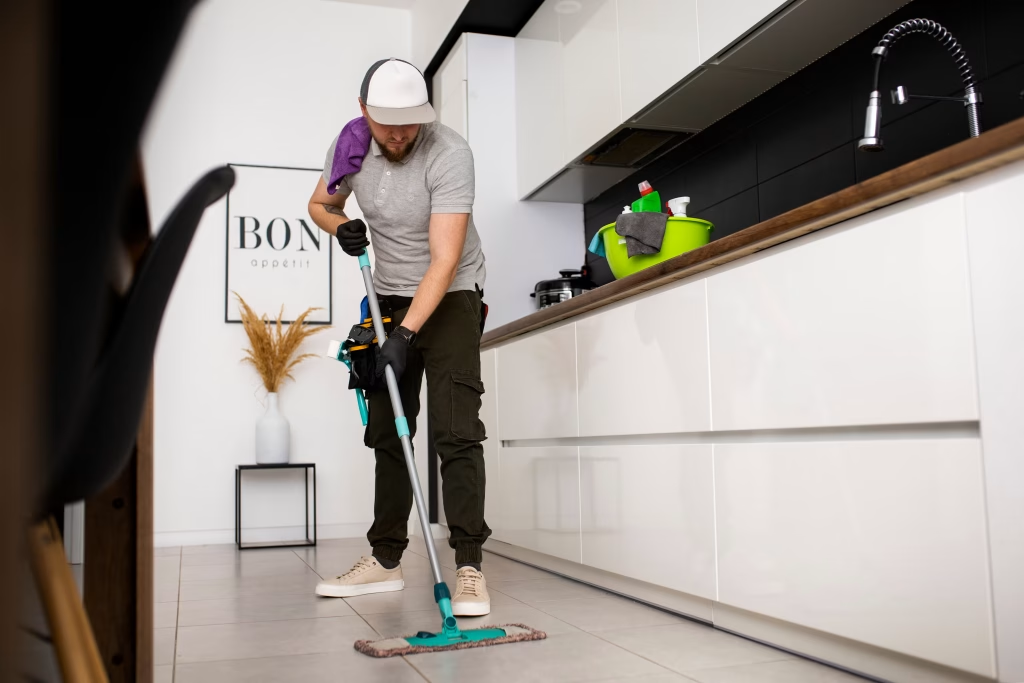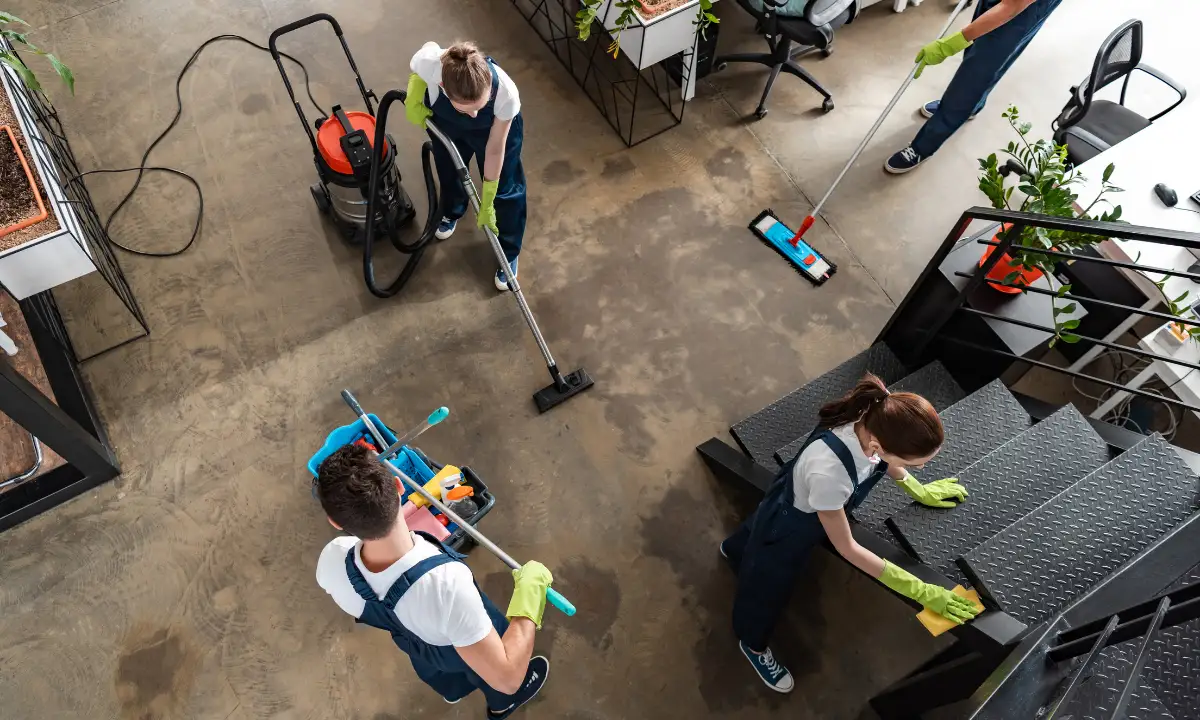
A lot of businesses sign a cleaning contract after one phone call and a low monthly quote, then spend the next six months dealing with problems nobody warned them about. The restrooms run out of paper towels every other week. The crew changes every month because the company uses rotating subcontractors instead of its own staff. A request for one extra service comes back with a fee nobody mentioned during the sales call. None of this shows up until the contract is already signed, because most business owners never ask the questions that would have caught it.
This happens because hiring a cleaning company usually gets treated like a small decision instead of what it actually is: a recurring contract that puts someone inside your building on a regular schedule, handling your trash, your restrooms, and often your after-hours access. A vague scope of work, an uninsured crew, or a contract with no real exit clause can cost far more than the monthly rate ever suggested. The short answer to avoiding all of this is straightforward: ask specific questions before you sign, not after something goes wrong. The 12 questions below cover exactly what to ask, what the answers should sound like, and what to watch for if a company can’t give you a straight answer.
Why the Right Questions Matter Before You Sign a Cleaning Contract
The cost of choosing the wrong cleaning company rarely shows up as a single obvious mistake. It shows up gradually, in a restroom that’s never quite stocked, a floor that looks fine on the surface but hasn’t been properly cared for in months, or a liability claim you didn’t expect to be responsible for because the crew working in your building wasn’t actually insured. A cleaning contract touches your facility’s appearance, your employees’ health, your compliance obligations, and your legal exposure all at once, which is a lot of weight to put on a decision made off a single quote. Asking the right questions upfront isn’t about being difficult with a sales rep; it’s about getting the same information you’d want before signing any other vendor contract that gives someone regular access to your building.
1. What’s Included in Your Standard Cleaning Package?
“Commercial cleaning” means something different at almost every company, and that gap is where most disputes start. One provider’s standard package might include restroom sanitation, trash removal, vacuuming, and surface dusting. Another provider might call that same list “basic janitorial” and treat restroom restocking, dusting, and floor care as separate add-ons billed on top of the base rate. Before you sign anything, ask for a written, itemized list of exactly what’s covered in the base price, broken down by area: restrooms, offices, common areas, break rooms, rather than a general description like “full-service cleaning.” If a company can’t produce this in writing, that’s a sign the scope will get renegotiated after you’re already locked into a contract, usually not in your favor.
2. Are You Insured, Bonded, and Compliant With Safety Regulations?
A cleaning crew working in your building after hours, handling chemicals and equipment, creates real liability exposure if something goes wrong. If a cleaner is injured on your property and the company doesn’t carry workers’ compensation insurance, your business can end up covering that cost. If a company isn’t carrying general liability coverage and something gets damaged during a cleaning visit, you’re left arguing over who pays for the repair. Ask directly whether the company carries general liability insurance, workers’ compensation coverage, and bonding, and ask them to provide a certificate of insurance rather than just taking their word for it. It’s also worth asking whether the company follows OSHA guidelines around chemical handling and hazard communication, since this affects how safely their staff uses cleaning products in your building.
3. Are Your Cleaners W-2 Employees, and How Are They Screened?
The people cleaning your building matter as much as the tasks on the checklist, and this is one question a lot of business owners never think to ask. Some cleaning companies employ their own staff directly, meaning the same trained, vetted people show up on a consistent schedule. Others rely on a rotating pool of subcontractors, which means you might get a different crew every few weeks with no guarantee of consistent training or accountability. Ask whether the company’s cleaners are direct W-2 employees or subcontracted labor, and ask specifically how staff are screened before being placed in a client’s building; background checks, in-person interviews, and reference checks are reasonable baseline expectations. A company that hesitates to answer this clearly, or that admits it doesn’t run background checks, is a company you’ll want to think twice about giving building access to.
4. Do You Have Experience With Facilities Like Mine?
A company that specializes in cleaning small offices isn’t necessarily equipped to handle a medical facility, and a provider used to retail spaces might not understand the compliance requirements of an industrial site. Every facility type comes with its own priorities: a dental office needs disinfection protocols that a standard office doesn’t, while a warehouse needs different floor care and debris management than a corporate headquarters. Ask the company directly about their experience with facilities similar to yours, and ask for examples of current or past clients in your industry if they’re willing to share them. A provider with real experience in your facility type will be able to speak specifically about the challenges that come with it, rather than giving a generic answer about how they clean “all types of businesses.”
5. How Do You Monitor Quality and Catch Problems Before I Do?
Even a well-trained crew can start cutting corners over time if nobody is checking their work. The difference between a cleaning company that maintains consistent quality and one that slowly declines usually comes down to whether they have an actual system for catching problems, rather than waiting for the client to complain. Ask whether the company uses on-site supervisors, scheduled walkthroughs, documented checklists, or performance inspections to monitor their own crews. A company with a real quality process should be able to describe it specifically: how often inspections happen, who conducts them, and what happens when a problem is found, rather than giving a vague assurance that “we take quality seriously.”
6. What Happens If My Regular Cleaner Is Out Sick or Leaves?
This is a question almost nobody thinks to ask, but it directly affects whether your service stays consistent. If the person or crew assigned to your building calls in sick, goes on vacation, or leaves the company entirely, what’s the plan? A well-run cleaning company has backup staff trained and ready to step in without a gap in service. A company without a real answer to this question is a company where a single staffing issue can mean your building goes uncleaned for a night, or gets serviced by someone unfamiliar with your specific requirements. Ask how backup coverage works and how quickly a replacement gets assigned if your regular cleaner is unavailable.
7. How Is Pricing Structured, and What Could Cost Extra?
This question is different from asking what’s included in the package; this is specifically about how the invoice works and where hidden costs tend to show up. Commercial cleaning is typically billed hourly, per visit, or as a flat monthly contract, and it’s worth understanding which model you’re being offered and why. More importantly, ask directly what triggers an additional charge. Does requesting extra trash pickup during a busy week cost more? Is carpet cleaning or floor stripping included, or billed separately as a project? Are cleaning supplies and restroom consumables included in the price, or does the facility need to supply them? Getting these answers in writing before signing prevents the situation where a “great rate” turns into a much higher bill once add-ons start showing up.
8. What Cleaning Products and Equipment Do You Use?
The products and equipment a cleaning company uses affect both the results you see and the indoor air quality of your building. Ask whether the company offers green or eco-friendly cleaning product options, particularly if you have employees with sensitivities to strong chemical odors or if sustainability is a priority for your business. It’s also worth asking about equipment quality. HEPA-filter vacuums, for example, capture more dust and allergens than standard vacuums, which matters in offices with heavy carpet use. A company that can speak clearly about what products and equipment they use, and why, is generally a company that’s invested more thought into the actual quality of the work than one that gives a vague answer about using “professional-grade” everything.
9. How Do I Report an Issue, and How Fast Will It Get Fixed?
Even with a good provider, something will eventually get missed: a restroom that wasn’t fully stocked, a spot that got overlooked, a request that didn’t get communicated to the crew. What matters is how easy it is to report the issue and how quickly it gets resolved. Ask whether you’ll have a dedicated point of contact or account manager, whether there’s an online portal or direct phone line for reporting problems, and what kind of response time you can realistically expect. A company that can only offer a general customer service line with no clear ownership of your account is a company where small issues are more likely to slip through the cracks.
10. Can You Scale If My Business Grows or Adds Locations?
If your business is likely to grow, move to a larger space, or add additional locations, it’s worth knowing upfront whether your cleaning provider can grow with you. Some companies are set up to handle a single small office and nothing beyond that, while others manage cleaning programs across multiple facilities with consistent standards at every site. Ask directly whether the company has experience servicing multiple locations for a single client, and how they maintain consistency across different sites if that applies to your situation. This question matters even if you’re not planning to expand immediately, because switching providers later, after you’ve built a working relationship, creates its own disruption.
11. What Are the Contract Terms, Cancellation Policy, and Price Guarantees?
This is the question most directly tied to the decision you’re actually making: signing a contract. Before agreeing to anything, ask how long the contract runs, whether it renews automatically, and what the process looks like if you need to cancel or switch providers because service isn’t meeting expectations. Ask whether pricing is locked in for a specific period or subject to change with notice, and if so, how much notice you’ll be given before a rate increase takes effect. A fair contract should give you a reasonable way out if the service doesn’t hold up, rather than locking you into a long term with no recourse. If a company is reluctant to explain their cancellation terms clearly, treat that as a sign the contract may be written to favor them more than you.
12. Can You Provide References From Clients Like Me?
Everything a cleaning company tells you during a sales conversation is, understandably, going to sound good. References and reviews are where you find out whether the answers to the previous 11 questions actually hold up in practice. Ask for references from current clients, ideally ones with a facility similar to yours in size or industry, and actually follow up with them. A short conversation with an existing client can tell you more about consistency, communication, and how problems get handled than any part of the sales pitch. It’s also worth looking at online reviews directly, paying attention not just to the star rating but to how the company responds to negative reviews, since that says a lot about how they’ll handle a real complaint from you.
Red Flags That Signal You Should Walk Away
A few warning signs tend to show up before a bad cleaning contract gets signed, and catching them early saves a lot of frustration later. Watch for a company that can’t produce proof of insurance when asked directly, one that won’t put the scope of work in writing and instead relies on verbal promises, or one that gives a vague or evasive answer when asked how staff are screened and background-checked. Heavy pressure to sign a contract the same day, without giving you time to check references or compare other quotes, is another sign worth taking seriously. Finally, if you ask for a reference and the company can’t provide even one current client willing to talk, that alone is reason enough to keep looking.
How to Compare Quotes From Multiple Cleaning Companies
The lowest quote isn’t always the best deal, and in commercial cleaning, it’s often the quote with the most exclusions built into it. A company that leaves out restroom restocking, prices floor care separately, or reduces visit frequency to hit a lower number on paper can look cheaper upfront while actually costing more once everything you actually need gets added back in. The most reliable way to compare quotes is to line each provider up against the same written scope of work; same areas, same tasks, same frequency, before comparing price at all. Once you’re comparing apples to apples, the real difference in value between providers becomes much easier to see, and it usually isn’t the company with the lowest number on the page.
Quick Reference: All 12 Questions at a Glance
| # | Question | What It Protects You From |
| 1 | What’s included in the package? | Scope disputes |
| 2 | Are you insured and compliant? | Liability exposure |
| 3 | Are staff W-2 and screened? | Inconsistent, unvetted crews |
| 4 | Experience with facilities like mine? | Compliance and quality gaps |
| 5 | How is quality monitored? | Declining service over time |
| 6 | Backup coverage for absences? | Missed cleanings |
| 7 | How is pricing structured? | Hidden fees |
| 8 | What products and equipment are used? | Air quality and safety concerns |
| 9 | How are issues reported? | Slow problem resolution |
| 10 | Can you scale with us? | Vendor changeover later |
| 11 | Contract terms and cancellation? | Being locked into bad service |
| 12 | Can you provide references? | Unverified claims |
Frequently Asked Questions
How much does commercial cleaning typically cost?
Pricing depends on square footage, cleaning frequency, and the scope of work involved, and it’s usually billed hourly, per visit, or as a flat monthly contract. Getting quotes based on the same written scope from multiple providers is the most reliable way to understand a fair price for your specific facility.
How long should a commercial cleaning contract be?
Many providers offer month-to-month or short-term agreements alongside longer annual contracts. A shorter initial term, or a contract with a clear cancellation clause, gives you room to evaluate a new provider before committing long term.
Is it normal to switch commercial cleaning companies?
Yes, businesses switch cleaning providers fairly often, usually because of inconsistent service, missed tasks, or unresolved communication issues. A contract with fair cancellation terms makes this transition far less disruptive when it becomes necessary.
Should I choose a local or national cleaning company?
A local company often provides more direct communication, faster response times, and a better understanding of the regional market, while a national company may offer more standardized processes across multiple locations. The right choice depends on whether consistency across many sites or responsiveness at a single site matters more to your business.
What’s the difference between janitorial services and commercial cleaning?
Janitorial services cover daily or routine upkeep, while commercial cleaning includes deeper, less frequent work like carpet extraction or floor care. For a full breakdown of how these two differ and when you need each one, see our guide on janitorial services vs. commercial cleaning.
Choosing the Right Commercial Cleaning Partner
Once you’ve gone through these 12 questions with a potential provider, you’re no longer choosing based on price alone, and that’s the point. A company that answers clearly on insurance, staffing, quality control, and contract terms is a company confident enough in its own operation to be transparent about it, while one that dodges these questions is telling you something too. RMS Cleaning works with businesses across New Jersey and builds every commercial cleaning plan around a written scope of work, direct W-2 staff, and clear pricing from the start, because that’s the standard we’d want to see if we were the ones asking the questions. If you’re evaluating providers right now, use this list as your checklist during every conversation, and don’t sign anything until every question on it has a straight answer.