Commercial cleaning costs are difficult to budget for because two businesses with identical square footage can receive wildly different quotes. A 5,000-square-foot open office with two restrooms simply doesn’t take the same labor as a 5,000-square-foot medical office with exam rooms, a busy waiting area, multiple sinks, and stricter sanitation requirements. The same logic applies to warehouses, retail stores, corporate offices, fitness facilities, and managed commercial properties.
In 2026, commercial cleaning is typically priced by the square foot, by the hour, per visit, or through a recurring monthly contract. National cleaning industry statistics generally place standard commercial cleaning at $0.10–$0.20 per square foot, while New Jersey office-cleaning guides more specifically cite $0.10–$0.18 per square foot per visit for standard office service. These are useful starting points, but your actual cost depends on cleanable area, service frequency, labor requirements, building layout, restroom count, floor surfaces, foot traffic, and the exact scope of work.
For New Jersey business owners, office managers, property managers, and facility teams, the better question isn’t What’s the going rate for commercial cleaning? It’s What should it cost to clean my specific property, at the standard and frequency I actually need? Understanding how a cleaning company builds its estimate is what makes it possible to set a realistic budget, compare proposals fairly, and avoid paying for services your facility doesn’t need.
Commercial Cleaning Costs in 2026: What Should You Budget?
Because businesses have such different service needs, commercial cleaning gets quoted in several different ways. A small office that only needs occasional attention is often priced hourly or per visit, while a larger building with recurring janitorial service is more likely to receive a fixed monthly proposal based on estimated workload. Angi’s 2026 national cost guide reports roughly $0.10–$0.20 per square foot for commercial cleaning, with hourly rates ranging from about $20 to $90 depending on the property and scope. New Jersey-focused 2026 pricing guides land in a tighter band, around $0.10–$0.18 per square foot per visit for standard office cleaning.
| Pricing Method | Common Use | What Determines the Final Price |
| Per square foot | Offices and larger commercial facilities | Cleanable area, facility type, frequency, and scope |
| Hourly | Small, irregular, or one-time jobs | Cleaner hours, crew size, and task difficulty |
| Per visit | Defined cleaning schedules | Work required during each visit |
| Monthly contract | Recurring janitorial services | Visits per month, labor, scope, and periodic work |
The unit attached to a rate matters as much as the number itself. A quote of $0.12 per square foot per visit is not the same as $0.12 per square foot per month and treating them as interchangeable will throw off any annual budget. Always confirm the billing period behind an advertised rate before using it to project your yearly cleaning spend.
What New Jersey Businesses Actually Pay
Commercial cleaning prices in New Jersey reflect the state’s labor market, insurance costs, property conditions, building access, parking, service schedule, and local operating expenses. Current NJ pricing guides commonly place standard recurring office cleaning around $0.10–$0.18 per square foot per visit, though any individual facility can fall outside that range depending on its demands. More labor-intensive properties push costs higher; open, lightly occupied offices tend to clean more efficiently.
| Facility Type | Typical Cleaning Workload | Relative Cost Tendency |
| Standard office | Routine janitorial cleaning | Lower to moderate |
| Corporate workplace | Offices, meeting rooms, kitchens, common areas | Moderate |
| Retail / showroom | Customer-facing floors, glass, restrooms | Moderate |
| Medical/dental office | Higher sanitation and surface-control needs | Moderate to higher |
| Warehouse | Large floor areas, dust, restrooms, loading areas | Varies widely |
| Fitness facility | Equipment, locker rooms, frequent high-touch cleaning | Moderate to higher |
| Property common areas | Lobbies, hallways, elevators, shared amenities | Depends heavily on traffic |
Treat these as workload indicators, not rigid price bands. A busy 4,000-square-foot office can require more cleaning labor than an 8,000-square-foot facility that sits half-empty. A credible estimate accounts for how a property is actually used not just how big it is.
Why Commercial Cleaning Prices Vary Across New Jersey
Location affects rates, but it’s only one factor among many. Parking restrictions, loading access, elevators, security procedures, after-hours entry rules, multiple floors, and a narrow nighttime cleaning window can all change how much labor a job really takes. A suburban office with easy parking and open floor space is often simpler to service than a similarly sized property with restricted access, several floors, dense workstations, and a tight overnight window. This is exactly why statewide averages should be treated as planning figures rather than quotes. RMS Cleaning serves businesses and commercial properties across New Jersey and bases its cleaning plans on property size, usage, schedule, and priority areas, not a one-size-fits-all square-foot calculation.
What Determines the Cost of Commercial Cleaning?
The single biggest driver of cost is the amount of work required to hit the agreed service standard. Square footage feeds into that, but a professional cleaning company also weighs frequency, room density, restroom and kitchen counts, occupancy, floor types, building condition, access requirements, specialized tasks, and labor time. These are the factors that explain why two similar-looking properties can land on very different price tags.
Cleanable Square Footage
Total square footage and cleanable square footage aren’t always the same thing. Mechanical rooms, secured areas, tenant-controlled spaces, storage sections, and unfinished areas may fall outside the cleaning contract entirely. A useful estimate starts with the space the cleaning team is actually responsible for. Larger facilities generally need more labor, equipment time, floor care, and trash removal, but the relationship isn’t perfectly linear. A large open floor can sometimes clean faster, per square foot, than a smaller space packed with private offices, cubicles, furniture, and individual trash cans.
Cleaning Frequency
Frequency drives both the monthly contract price and the workload of each visit. Businesses commonly schedule service once weekly, twice weekly, three times a week, five days a week, or nightly, depending on occupancy and cleanliness standards. More visits generally means a higher total monthly cost, simply because more labor is being purchased. That said, each visit often gets more efficient as frequency increases. Floors accumulate less dirt, trash doesn’t pile up, and restrooms stay closer to a maintained baseline, meaning less corrective work per visit. More frequent cleaning won’t automatically shrink the monthly bill, but it does tend to lighten the workload of any single visit compared to letting a full week of soil and waste build up.
Facility Layout and Workspace Density
Layout drives productivity directly. An open floor plan lets cleaners move efficiently through large areas, while a dense layout cubicles, private offices, conference rooms, interior glass, stairways, and furniture creates far more individual surfaces and obstacles to work around. Picture two 10,000-square-foot buildings: one is an open warehouse with a small office and two restrooms; the other has 60 workstations, eight private offices, four conference rooms, several glass partitions, a kitchen, and six restrooms. Same square footage, very different labor hours. A quote that ignores layout density will almost always be misleading.
Restrooms, Kitchens, and Breakrooms
Restrooms, commercial kitchens, and breakrooms typically demand more labor per square foot than open office space. Restroom work covers toilets, urinals, sinks, mirrors, partitions, counters, floors, dispensers, high-touch surfaces, and supply restocking. Breakrooms add counters, sinks, appliance exteriors, tables, floors, food residue, and trash management. Restroom and fixture count can move the needle on labor more than most businesses expect. A building with several high-use restrooms can cost more to maintain than a larger facility with fewer wet areas.
Employee Count and Foot Traffic
Occupancy dictates how fast a space gets dirty. More employees, customers, tenants, patients, or visitors means more trash, restroom use, fingerprints, floor soil, and contact with high-touch surfaces. A hybrid office with 15 people on-site most days needs a different schedule than a similarly sized office occupied by 75 employees every weekday. Retail stores and gyms can see heavy customer traffic even with a small staff count, so a good cleaning schedule should reflect actual usage, not just square footage.
Floor and Surface Types
Carpet, VCT, tile, grout, polished concrete, and hardwood each carry different maintenance requirements. Routine carpet care usually means vacuuming and spot treatment; hard floors may need sweeping, damp mopping, machine scrubbing, or periodic buffing. Specialized floor restoration carpet extraction, stripping and waxing, grout restoration, refinishing is a different category of work altogether, requiring extra labor, chemicals, and machine and drying time. These jobs are usually quoted separately from the recurring contract.
Current Condition of the Facility
A property with a consistent cleaning history is generally easier to maintain than one carrying months of accumulated dust, floor soil, grease, and neglected detail work. That gap often shows up as a difference between the initial clean and ongoing recurring service. Many contractors recommend a deeper first visit to bring the building to a manageable baseline before starting routine maintenance. After that reset, recurring visits can focus on upkeep instead of correcting long-term buildup every time.
Access, Schedule, and Security Requirements
Scheduling changes productivity. After-hours cleaning often lets crews work efficiently without navigating around employees or customers, but restricted access windows, weekend-only schedules, security procedures, key or alarm management, parking limitations, and locked areas can all add operational time. RMS Cleaning’s quote process specifically asks about service frequency, after-hours access, key or alarm procedures, insurance documentation, areas to be cleaned, and any special requirements details that shape the real working conditions behind a price.
Specialized Cleaning Requirements
Routine office janitorial work is a different job than healthcare cleaning, industrial cleaning, deep cleaning, post-construction cleanup, high dusting, floor restoration, or specialized disinfection, each requiring its own chemicals, equipment, PPE, training, and time. Medical and dental facilities, for instance, typically need more attention to high-touch surfaces, cross-contamination control, and disinfectant selection. Note: OSHA is not a medical-cleaning pricing standard; its role centers on workplace and worker safety. The cleaning program itself should be built around the facility’s actual use, hazards, and internal policies.
How Commercial Cleaning Companies Build a Quote
Professional cleaning pricing ultimately comes down to a workload calculation: which areas need service, which tasks are required, how often, how many labor hours that adds up to, and what supplies, equipment, supervision, and overhead are needed to deliver it consistently.
Step 1: Facility Walkthrough. A walkthrough surfaces details that square footage alone can’t: restroom count, office layout, flooring, elevators, stairways, high-traffic zones, waste volume, special-use rooms, and overall building condition. RMS Cleaning offers an in-person walkthrough for larger or more complex properties before finalizing a proposal.
Step 2: Define the Scope of Work (SOW). The SOW spells out exactly what the contractor is responsible for: rooms included, tasks, frequency, service standards, supplies, periodic work, and exclusions. A clear SOW protects both sides and makes it possible to compare competing bids apples-to-apples.
Step 3: Estimate Labor. The provider estimates task duration based on size, layout, service level, occupancy, frequency, and crew productivity. Production rates are a useful tool, but no single rate should be applied blindly across an entire building; vacuuming open carpet, scrubbing a multi-stall restroom, and wiping office surfaces all take different amounts of time.
Step 4: Account for Supplies, Equipment, and Supervision. Chemicals, disinfectants, microfiber cloths, trash liners, vacuums, mops, floor machines, transportation, quality checks, insurance, and management all carry real cost for the provider even before specialized floor equipment enters the picture.
Step 5: Convert Workload Into a Price. Once workload and overhead are known, they translate into a per-visit price, hourly rate, monthly contract, or project fee. Recurring service is usually converted into a predictable monthly number so the business can budget consistently. There’s no universal formula square footage × national rate that produces an accurate price on its own; benchmarks are for comparison, not calculation.
Commercial Cleaning Cost by Facility Type
Different facility types demand different work, which is exactly why office, retail, medical, warehouse, and property cleaning shouldn’t automatically carry the same per-square-foot price.
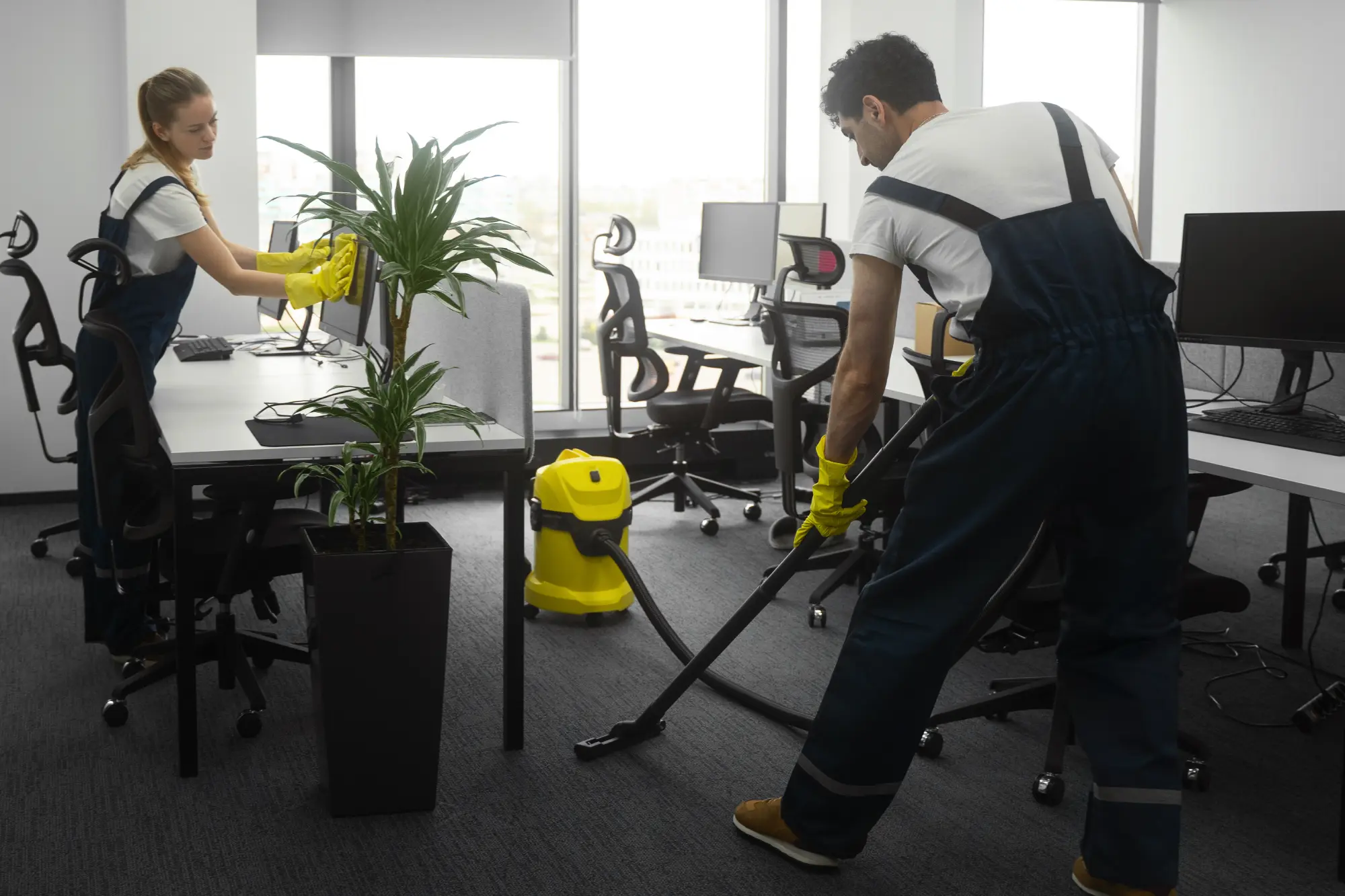
Office and Corporate Cleaning. Centers on workstations, conference rooms, reception areas, breakrooms, restrooms, carpets, hard floors, trash, recycling, entrance glass, and high-touch surfaces. Open floor plans clean efficiently; private offices and dense cubicle layouts add movement and surface count. RMS Cleaning provides commercial and office cleaning across New Jersey, covering dusting, vacuuming or mopping, restroom sanitation, trash and recycling removal, and breakroom or kitchen service.
Retail Store and Showroom Cleaning. Customer-facing presentation takes priority: entrance glass, showroom floors, displays, fitting areas, counters, and customer restrooms need frequent attention. A store seeing hundreds of daily visitors can need more floor and restroom maintenance than a similarly sized office with a small team.
Medical and Dental Office Cleaning. Greater sanitation control is the norm, since exam rooms, treatment areas, waiting rooms, and high-touch surfaces see patients all day. Appropriate disinfectants, cross-contamination protocols, and site-specific procedures add labor and training time. A small dental office and a high-volume specialty clinic can have very different service needs.
Warehouse and Light Industrial Cleaning. Can look inexpensive on a per-square-foot basis because the space is often open, but size is only part of the story. Concrete floors, loading areas, high ceilings, industrial dust, employee restrooms, breakrooms, and hard-to-reach surfaces add real work, often calling for commercial sweepers or floor scrubbers.
Fitness Center and Gym Cleaning. Combines high occupancy with repeated contact on shared equipment. Cleaning spans equipment, floors, locker rooms, showers, mirrors, restrooms, and drinking stations. Humidity, sweat, odor, and heavy member traffic often push up the cleaning frequency needed to keep the space presentable.
Property Management and Common-Area Cleaning. Covers lobbies, hallways, stairwells, elevators, shared restrooms, laundry rooms, and amenity spaces. Workload depends heavily on tenant traffic, building size, floor count, and waste volume. RMS Cleaning includes property management and recurring common-area cleaning within its New Jersey commercial services.
Commercial Cleaning Costs by Building Size
Size helps establish an initial budget, but a square-footage table is never a guaranteed quote. A 20,000-square-foot open facility can sometimes clean more efficiently, per square foot, than a highly divided 5,000-square-foot office. Use the figures below as planning categories, not fixed prices.
| Facility Size | Common Example | Typical Cost Drivers |
| Under ~ 2,000 sq. ft. | Small professional office | Minimum visit time, restrooms, frequency |
| ~ 2,000–5,000 sq. ft. | Office, clinic, or retail space | Occupancy, layout, floors, kitchens |
| ~ 5,000–10,000 sq. ft. | Mid-size office or showroom | Labor hours, restroom count, frequency |
| ~ 10,000–20,000 sq. ft. | Corporate or mixed commercial property | Crew size, density, floor care, access |
| ~ 20,000–50,000+ sq. ft. | Large office, warehouse, or facility | Production efficiency, equipment, specialty areas |
Larger buildings sometimes get a lower unit cost, since setup time, internal travel, and equipment use spread across more square footage. That advantage disappears fast if the building has many restrooms, cubicles, kitchens, stairwells, high ceilings, or specialty areas.
Worked Example: A 5,000-Square-Foot Office
Picture a fictional 5,000-square-foot New Jersey office with moderate foot traffic, two restrooms, one breakroom, mixed carpet and hard flooring, and janitorial service three evenings a week. The scope: trash removal, vacuuming, hard-floor cleaning, restroom sanitation, breakroom cleaning, dusting, and basic high-touch cleaning. A simple square-foot benchmark provides a starting range, but a real provider still has to estimate labor based on layout, restroom use, current condition, access, and service expectations. Applying a market rate mechanically without matching it to actual scope, frequency, and productivity can produce a monthly figure that has little to do with the building in question. The takeaway: a quoted monthly cost should be traceable back to workload. If two companies give very different proposals for the same 5,000-square-foot office, compare their schedules, estimated service hours, included tasks, floor work, restocking duties, and exclusions before assuming one is simply cheaper.
What’s Included in Standard Commercial Janitorial Cleaning?
Standard janitorial service covers the routine work needed to maintain a workplace between visits:
- Trash and recycling removal
- Vacuuming carpets
- Sweeping and mopping hard floors
- Dusting accessible surfaces
- Restroom cleaning and sanitizing
- Breakroom or kitchen surface cleaning
- High-touch surface cleaning
- Spot-cleaning glass and doors
Specialized projects carpet extraction, floor stripping and waxing, detailed window cleaning, high dusting, post-construction cleanup, pressure washing, or intensive deep cleaning usually fall outside the standard recurring scope. Confirm these before comparing monthly prices across providers.
Add-Ons That Can Increase the Quote
| Service | Why It Costs Extra | Common Pricing Approach |
| Carpet cleaning | Extraction equipment and added labor | Per sq. ft. or project |
| Floor stripping and waxing | Chemicals, machines, multi-step process | Per sq. ft. or project |
| Window cleaning | Access requirements and detail work | Per pane/project |
| High dusting | Elevated surfaces, access equipment | Hourly / project |
| Post-construction cleaning | Heavy dust, debris, detailed cleanup | Project / sq. ft. |
| Pressure washing | Specialized equipment, exterior work | Area/project |
| Specialized disinfection | Products, procedures, added dwell time | Area/project |
RMS Cleaning offers commercial cleaning, deep cleaning, recurring cleaning, office cleaning, post-construction work, specialty cleaning, property services, hospitality cleaning, and pressure washing, allowing services to be combined around a property’s actual needs.
Cleaning Supplies and Consumables: What’s Actually Included?
Supplies included mean different things depending on the contract. Cleaning chemicals, disinfectants, microfiber cloths, mop products, and vacuum equipment used by the cleaning crew are different from building consumables like toilet paper, paper towels, hand soap, and dispenser refills. Some businesses buy restroom consumables themselves and simply have the crew restock them; others let the provider manage inventory and bill for it. Trash liners are handled differently depending on the agreement, too. A solid proposal states clearly who supplies each category; otherwise, a seemingly inexpensive contract can get more expensive once paper goods, liners, and soap are added on.
Why the Lowest Bid Isn’t Always the Lowest Cost
A low quote can be entirely legitimate if the provider runs an efficient operation or the property is easy to maintain. The problem shows up when a low bid is built on too few labor hours, missing tasks, vague service standards, excluded floor care, or unrealistic expectations about what one cleaner can finish per visit. A company might look cheaper because restroom consumables are excluded, periodic floor work is billed separately, high dusting is skipped, or certain tasks happen less often than you’d assume. Businesses can also absorb hidden costs through repeated callbacks, missed cleaning, damaged surfaces, inconsistent staffing, and the management time it takes to fix service problems. Navigating low commercial cleaning quotes often reveals missing tasks or excluded floor care.
The better question isn’t which price is lowest? It’s what workload and service level does this price actually buy?
Frequently Asked Questions
How much does commercial cleaning cost per square foot in 2026?
National data puts commercial cleaning at roughly $0.10–$0.20 per square foot, while 2026 New Jersey office-cleaning guides more specifically cite $0.10–$0.18 per square foot per visit for standard service. Facility type, scope, frequency, layout, labor, and local conditions can all push a quote outside these ranges.
How much do commercial cleaners charge per hour?
Angi’s 2026 national data reports roughly $20–$90 per hour, varying by location, crew structure, task type, and whether the figure refers to a single cleaner-hour or the total job.
How much does office cleaning cost per month?
Monthly cost depends primarily on square footage, number of visits, labor needs, restroom usage, layout, and scope. NJ market guides show recurring contracts vary substantially with frequency, which is why a monthly estimate should be built around the actual property rather than a single statewide average.
How much does it cost to clean a 10,000-square-foot commercial building?
There’s no single reliable price; a 10,000-square-foot office, medical clinic, retail store, warehouse, and fitness center all require very different labor. Start from a verified market benchmark, then adjust for frequency, restrooms, occupancy, layout, floors, access, and specialized work.
Are cleaning supplies included in commercial cleaning prices?
Chemicals and equipment used by the crew are usually included, but restroom consumables paper towels, toilet paper, hand soap may be supplied by the client or billed separately. The proposal should specify who provides what.
Why can two cleaning companies quote very different prices for the same building?
They may be estimating different labor hours, frequencies, staffing levels, tasks, supplies, floor services, or quality-control standards, and one bid may exclude something the other includes. Compare scope of work before comparing price.
Does commercial cleaning cost more after hours or on weekends?
It can, especially if the schedule adds staffing, travel, security, parking, or access requirements. After-hours work can also boost productivity by letting crews work without disrupting employees or customers; the net effect depends on the provider and the facility.
Do commercial cleaning companies require long-term contracts?
Terms vary by provider and service type. Some recurring programs use longer agreements; others are shorter and more flexible. Review contract duration, cancellation terms, price-adjustment language, and scope-change process before signing.
Get a Commercial Cleaning Quote Based on Your Facility
Averages are useful for setting expectations, but your building’s real cost comes from its actual workload; square footage is just the starting point. The final number should also account for cleaning frequency, facility type, restrooms, kitchens, floors, occupancy, access, labor, specialized services, and the agreed scope of work. RMS Cleaning provides commercial cleaning, office cleaning, recurring cleaning, corporate cleaning, deep cleaning, post-construction cleaning, property cleaning, hospitality cleaning, and other professional services across New Jersey. Its process factors in the property, schedule, service areas, and special requirements before pricing the job, and its cleaners are W-2 employees, backed by general liability and workers’ compensation insurance.
If you’re budgeting for a New Jersey office, commercial building, managed property, or facility, the most useful next step is a facility-specific quote. A proper walkthrough and scope of work will tell you far more about what you should actually pay than any generic square-foot rate.