Reviewed and Updated: July 21,2026
Germs can remain on door handles, desks, switches, railings, shared equipment and other high-touch surfaces even after a room looks clean. Standard spray-and-wipe cleaning works well for many areas, but it can be harder to apply disinfectant evenly across curved equipment, chair backs, narrow edges and object undersides. Electrostatic disinfection offers another way to apply disinfectant across exposed surfaces, especially in offices, schools, gyms, healthcare settings and other busy properties. However, the sprayer itself does not kill germs. Effective treatment still depends on pre-cleaning, the correct disinfectant, proper surface wetness and full contact time.
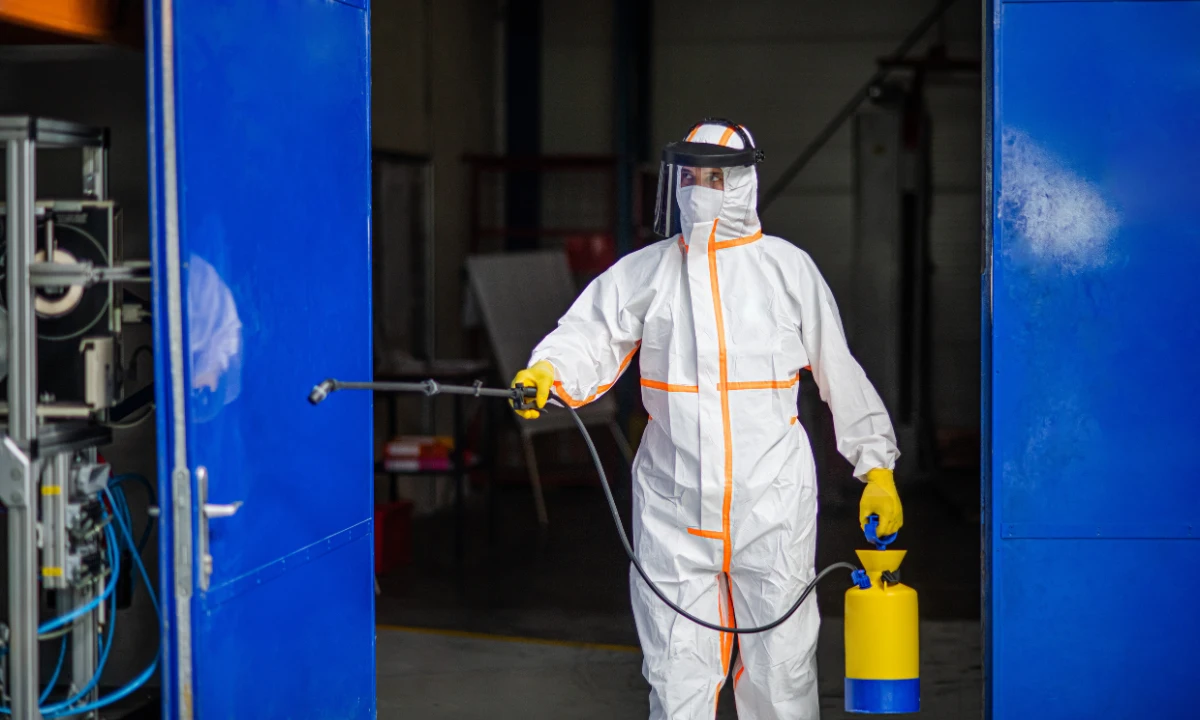
Electrostatic disinfection is a surface-treatment method that uses a specialized sprayer to give disinfectant droplets an electrical charge. The charged droplets spread apart and move toward exposed surfaces, helping create a more even coating around objects. The disinfectant, rather than the electrical charge, inactivates listed pathogens when its label directions are followed.
What Is Electrostatic Disinfection?
Electrostatic disinfection is a method of applying liquid disinfectant to environmental surfaces. A specialized electrostatic sprayer breaks the solution into small droplets and gives those droplets an electrical charge as they leave the nozzle. This charge can help the spray deposit across exposed surfaces more consistently than an ordinary trigger spray, particularly on objects with curves, edges and irregular shapes. The process is used as part of environmental cleaning and infection-control programs in homes, offices, commercial buildings, schools, gyms and other shared spaces. It should be understood as a disinfectant application method rather than a replacement for cleaning. Dust, grease, food residue, spills and other visible soil usually need to be removed before the disinfectant is applied. RMS Cleaning provides residential and commercial disinfecting services across New Jersey, including electrostatic application for suitable commercial spaces. Our service range covers offices, homes, rental properties, retail spaces and other local facilities.
Cleaning, Sanitizing and Disinfecting Are Different
Cleaning, sanitizing and disinfecting are related, but they do not perform the same job. Understanding the difference is important because electrostatic spraying usually takes place after the necessary cleaning has been completed.
| Process | Main purpose | Typical result |
| Cleaning | Removes dirt, dust, grease, debris and some microorganisms | Leaves a visibly cleaner surface |
| Sanitizing | Reduces certain microorganisms to a specified level | Lowers the number of listed germs |
| Disinfecting | Inactivates listed pathogens on suitable surfaces | Provides pathogen-specific surface treatment |
| Electrostatic spraying | Applies a compatible disinfectant through charged droplets | Supports more even disinfectant distribution |
| Sterilizing | Eliminates all forms of microbial life under defined conditions | Used in controlled medical or industrial processes |
How Does Electrostatic Disinfection Work?
Electrostatic disinfection combines liquid atomization, electrical charging and controlled chemical application. The technology can improve how droplets deposit on exposed objects, but the final result depends on the sprayer, disinfectant, surface material, operator technique and room conditions.
1. The Sprayer Atomizes the Disinfectant Solution
The process begins inside the electrostatic sprayer. A pump moves the disinfectant from its tank through a spray nozzle. The nozzle breaks the liquid into small droplets, creating an atomized spray that can be distributed across a wider area. Droplet size and flow rate affect how the spray behaves. Very large droplets may fall quickly and create pooling, while very small droplets may remain in the air longer and increase inhalation concerns. EPA electrostatic spray directions require specific droplet, distance, contact-time and safety information to be supported on product labels.
2. An Electrode Charges the Droplets
As the liquid moves through or near the nozzle, an electrode adds an electrical charge to the spray. Many battery-powered systems produce positively charged droplets, although equipment can differ. EPA testing has found both positive and negative spray charges among electrostatic systems, so “electrically charged droplets” is more accurate than claiming that every machine always produces a positive charge. The charge does not change the disinfectant into a stronger chemical. It mainly affects the movement and deposition of the droplets. The antimicrobial action still comes from the active ingredients in the selected disinfectant.
3. Charged Droplets Spread Apart
Droplets with the same electrical polarity repel one another. This repulsion helps separate the atomized particles as they leave the nozzle, supporting a wider and more consistent spray pattern. This controlled distribution may reduce heavy concentration in one spot, but it does not remove the need for proper spray distance, overlapping passes and careful operator movement. Applying too quickly may leave dry gaps. Applying too slowly may cause runoff, residue or liquid pooling.
4. The Spray Moves Toward Exposed Surfaces
Charged droplets can be attracted to grounded, neutral or differently charged surfaces. This electrostatic attraction can support deposition on desks, chair backs, railings, equipment, handles and other three-dimensional objects. The effect is often described as “wraparound coverage.” In practical use, this means droplets may reach some sides, edges and undersides that are difficult to coat with one direct spray. It should not be presented as guaranteed 360-degree coverage. EPA researchers found that the measured wraparound effect was limited for several tested sprayers, regardless of the presence of charge. A trained operator must still approach difficult objects from suitable directions. Covered surfaces, enclosed compartments and areas blocked by solid objects may remain untreated.
5. The Surface Stays Wet for the Required Contact Time
After application, the disinfectant must remain on the surface for the contact time shown on its label. Contact time, dwell time and wet contact time refer to the period during which the surface must remain visibly wet for the product to deliver its registered pathogen claim. This step is critical. Applying a very light coat may save chemical, but it may also allow the surface to dry before the required time has passed. Contact time is not the same for every disinfectant or pathogen. One label may require one minute for a specific virus and a longer period for certain bacteria or fungi. The operator must follow the instructions for the exact product, surface and target organism.
What Determines Whether Electrostatic Disinfection Is Effective?
Electrostatic spraying can improve disinfectant distribution, but even coverage alone does not guarantee successful disinfection. The process works as a system. The chemical, equipment, surface, amount applied, contact time and operator technique must all align.
The Disinfectant Must Match the Target Pathogen
EPA-registered disinfectants carry specific claims based on reviewed efficacy data. A product may be registered for use against certain bacteria, viruses, fungi or other microorganisms, but that does not mean it works against every pathogen.
The product label should identify:
- The EPA registration number
- Target microorganisms
- Approved surface types
- Permitted use sites
- Required dilution
- Application method
- Spray distance
- Contact time
- Personal protective equipment
- Re-entry or ventilation instructions
The EPA registration number is a useful way to identify the actual product because the same formulation may be sold under different brand names.
Dirty Surfaces Need to Be Cleaned First
Dust, grease, food residue, body fluids and other organic material can create a barrier between the disinfectant and the microorganisms underneath. A surface may look lightly soiled while still having enough residue to interfere with chemical contact.
Pre-cleaning may include:
- Removing loose debris
- Dry or wet dusting
- Washing with soap or detergent
- Wiping oily surfaces
- Cleaning spills or body fluids
- Allowing the surface to reach the condition required by the label
Some products combine cleaning and disinfecting claims, but their directions still control how they should be used. Heavily soiled surfaces commonly require a separate cleaning step. Electrostatic spraying should therefore form part of a complete cleaning and disinfection plan. It should not be used to spray chemicals over visible dirt in the hope that the dirt will disappear.
The Correct Amount of Disinfectant Must Be Applied
An effective application needs enough liquid to cover the target surface and maintain wet contact time. Too little solution may dry before the product can work. Too much can cause drips, pooling, residue, unnecessary chemical use and possible material damage.
Correct application depends on:
- Spray distance
- Nozzle setting
- Flow rate
- Walking speed
- Angle of application
- Overlapping passes
- Surface orientation
- Material absorbency
- Air movement
- Temperature and humidity
EPA testing found that drying can vary between vertical and horizontal surfaces and between glass, plastic and metal. Some tested areas became partly or fully dry before ten minutes had passed, showing why operators should check actual surface wetness rather than assuming a room has received enough product.
Benefits and Limitations of Electrostatic Spraying
Electrostatic spraying can provide useful operational benefits, but it should be presented as one tool within a broader cleaning program. A balanced understanding helps property owners decide whether the method is suitable for their space.
More Consistent Coverage of Irregular Objects
One of the main advantages is improved disinfectant deposition on exposed three-dimensional surfaces. Charged droplets may coat curves, narrow edges, chair legs, railings, equipment frames and some undersides more evenly than a conventional one-direction spray.
This can be useful for:
- Office furniture
- Exercise equipment
- Shared tools
- Wheelchairs and walkers
- School desks and chairs
- Checkout counters
- Door hardware
- Shelving
- Breakroom surfaces
- Reception furniture
The benefit is strongest where many exposed objects need chemical application. It is less useful for hidden spaces that cannot be reached by a clear spray path.
Efficient Treatment of Larger Areas
A handheld or backpack electrostatic sprayer can apply disinfectant across a larger number of surfaces without requiring the operator to use a trigger bottle on every object.
This may support:
- Faster chemical application
- More consistent treatment between rooms
- Reduced physical wiping during the disinfection stage
- Better access to hard-to-wipe shapes
- Controlled coverage across large facilities
- Less disruption during scheduled treatment
Speed should never take priority over contact time. Moving through the room quickly is not helpful if the surface does not receive enough liquid to remain wet.
Controlled, Touch-Free Disinfectant Application
Electrostatic application can reduce the need to touch every surface with a cloth during the disinfection stage. This may help limit cross-contamination caused by using the same cleaning cloth across several objects. It may also reduce uncontrolled spray drift and chemical waste when the machine, product and technique work well together. Still, “touch-free” does not mean “cleaning-free.” Manual wiping or scrubbing remains necessary where soil must be physically removed.
Important Limitations
Electrostatic disinfection has clear boundaries:
- It does not remove dirt, dust bunnies, hair, grease or debris.
- It cannot reach through furniture, closed cabinets or solid barriers.
- It does not guarantee complete wraparound coverage.
- It does not sterilize ordinary rooms.
- It may not be suitable for every surface or device.
- It does not provide permanent protection from recontamination.
- It can leave residue, depending on the product and application amount.
- It may create inhalation or chemical-exposure concerns if used incorrectly.
- It may be unnecessary where routine cleaning or targeted disinfection is sufficient.
Electrostatic spraying should be selected after considering the reason for treatment, property layout, occupancy, surfaces and product-label requirements.
Electrostatic Disinfection Safety and Chemical Selection
Safety depends on the disinfectant, equipment, application conditions and operator controls. A product described as suitable for ordinary wiping may carry different precautions when sprayed into the air as small droplets.
Use an EPA-Registered Product Labeled for Electrostatic Application
The product label is the main source of instructions. It states where the chemical can be used, which organisms it targets, how it should be applied and how long it must remain wet.
Before application, the operator should confirm:
- The EPA registration number
- Approved use sites
- Suitable surface types
- Electrostatic spray directions
- Minimum and maximum spray distance
- Required contact time
- Dilution instructions
- Required PPE
- Ventilation or re-entry instructions
- Any wiping or rinsing requirements
EPA requires electrostatic spray directions to address contact time, supported spray distance, wetness, bystander controls and PPE.
Review the Safety Data Sheet
The Safety Data Sheet, commonly called the SDS, provides information about the chemical’s hazards and safe handling. It may cover:
- Required gloves and eye protection
- Respiratory precautions
- First-aid measures
- Flammability
- Ventilation
- Spill response
- Chemical incompatibilities
- Storage conditions
- Disposal
- Exposure risks
The label and SDS should be reviewed together. Equipment instructions should also be followed, since a chemical may be compatible with one sprayer but unsuitable for another.
PPE, Room Evacuation and Re-Entry
Electrostatic application can create airborne droplets that may be inhaled. EPA notes that smaller droplets can travel deeper into the respiratory tract, while some active ingredients may also enter the vapor phase.
PPE requirements may include:
- Chemical-resistant gloves
- Eye protection
- Protective clothing
- Suitable footwear
- An N95 filtering facepiece
- A respirator with chemical-specific cartridges
The correct protection depends on the label and SDS. One standard PPE set should not be assumed for every chemical.
Unprotected people and pets should not remain in the room during application where the label requires their removal. The area may also need to remain vacant during the contact period and until ventilation or re-entry conditions have been met. EPA electrostatic spray guidance specifically calls for bystanders and pets to remain outside the treatment room during application.
Flammability and Chemical Handling
Some alcohol-based or solvent-containing disinfectants may be flammable. Spraying a flammable liquid into small droplets can increase concern around sparks, open flames, hot equipment and electrical sources.
Safe chemical handling includes:
- Checking the SDS for fire hazards
- Removing ignition sources where required
- Avoiding smoking or open flames
- Using approved storage containers
- Keeping products in their original labeled containers
- Following correct dilution instructions
- Never mixing chemicals unless expressly directed
- Cleaning spills according to the SDS
- Disposing of unused solution properly
Bleach should never be mixed with ammonia, acids or other cleaners because dangerous gases can form.
Electronics, Wood and Other Sensitive Surfaces
Electrostatic spray should be used carefully around electronics. Computer ports, vents, outlets, fans, keyboards, control panels and electrical connections should not be saturated. Sensitive equipment may need to be powered down, covered or treated through a controlled manual method. Finished wood, painted surfaces, natural stone, fabrics and metals may react differently to disinfectants. The active ingredient may cause discoloration, corrosion, residue, swelling or coating damage.
Before broad application:
- Confirm surface compatibility
- Review the equipment manufacturer’s guidance
- Test an inconspicuous area where appropriate
- Avoid direct spray into openings
- Prevent liquid pooling
- Follow soft-surface directions separately
- Complete any required rinse on food-contact surfaces
A product labeled for hard, nonporous surfaces should not automatically be used on upholstery, carpet or unfinished wood.
Where and When Is Electrostatic Disinfection Most Useful?
Electrostatic spraying is most useful where many exposed surfaces, shared objects or irregularly shaped items need disinfectant application. The need should be assessed based on risk and property use rather than treating every room the same way.
Offices and Corporate Buildings
Offices contain many shared touchpoints, including door handles, elevator buttons, meeting tables, reception furniture, breakroom fixtures, phones and shared workstations. Electrostatic application may support scheduled disinfection after pre-cleaning, particularly in busy offices with many rooms or shared surfaces. Keyboards, computer towers and other electronics need extra care. They should not be sprayed in a way that allows moisture to enter openings.
Schools and Childcare Facilities
Desks, chairs, railings, shared equipment and activity surfaces may be suitable for treatment when the selected disinfectant is labeled for the use site and material. Room evacuation, re-entry, food-contact precautions and child exposure require close attention. Toys, fabrics and soft surfaces should be treated only where the product label allows it.
Gyms and Fitness Centers
Fitness spaces contain many curved and irregular objects, including weight machines, handles, benches, racks and shared exercise equipment. These shapes can make manual application slower and less consistent. Sweat and visible residue still need to be cleaned first. Electrostatic spraying should not be applied directly over dirty exercise equipment.
Medical Offices and Healthcare Facilities
Electrostatic application may be considered for certain noncritical environmental surfaces, such as waiting-room furniture, carts, chair frames and selected room surfaces. Facility infection-control procedures and equipment manufacturer instructions take priority. General room spraying does not replace required medical-device reprocessing, terminal-cleaning procedures or sterilization for critical equipment.
Retail, Hospitality and Commercial Properties
Retail counters, guest-room touchpoints, lobbies, elevators, shared seating and service areas may benefit from controlled surface disinfection. Electrostatic application can also support hotel, Airbnb and commercial turnover work where many surfaces must be prepared within a scheduled period.
Homes and Apartments
Residential electrostatic disinfection may be considered:
- After illness in the household
- During move-in or move-out cleaning
- Before or after a large gathering
- During short-term rental turnover
- For shared living areas
- Where many high-touch surfaces require treatment
The home should still be assessed for children, pets, food, electronics, ventilation and sensitive materials before spraying begins.
Electrostatic Disinfection vs. Other Methods
No single treatment method is best for every space. Each option serves a different purpose and may work best as part of a combined cleaning plan.
| Method | Primary function | Main strength | Main limitation |
| Electrostatic spraying | Applies charged disinfectant droplets | Useful for exposed, irregular surfaces | Requires compatible chemical and full contact time |
| Manual spray and wipe | Applies product and physically wipes surfaces | Supports soil removal and precise treatment | Labor-intensive across large areas |
| Conventional spraying | Applies uncharged droplets | Simple for direct surface treatment | May produce uneven coverage or runoff |
| ULV fogging | Disperses very fine droplets | Broad dispersion in permitted applications | Different exposure and labeling controls |
| UV-C treatment | Uses ultraviolet energy | Chemical-free treatment | Shadowing and line-of-sight limits |
| Routine cleaning | Removes dirt and contaminants | Essential for visible soil removal | Does not automatically provide pathogen-specific disinfection |
How Long Does Treatment Take and How Often Is It Needed?
Electrostatic disinfection does not have one standard duration or frequency. A small residential room and a large commercial facility require very different preparation, application and re-entry plans.
Factors That Affect Service Time
The total service period may include assessment, cleaning, room preparation, spraying, contact time, ventilation, inspection and equipment cleanup.
The duration depends on:
- Square footage
- Number of rooms
- Surface density
- Amount of visible soil
- Furniture and obstacles
- Product contact time
- Ventilation
- Sensitive equipment
- Food-contact requirements
- Number of technicians
- Access and scheduling restrictions
A fast spray application does not mean the room can be reopened immediately. Contact and re-entry periods must still be observed.
How Long Does the Protection Last?
Standard electrostatic disinfection treats susceptible microorganisms present on the surface during application. It does not normally create permanent protection. A disinfected desk can be contaminated again when it is touched. A door handle can receive new germs as soon as people begin using it. Any claim of residual or long-term activity should be supported by the specific product label.
How Often Should Electrostatic Disinfection Be Used?
Frequency should depend on actual need, including:
- Occupancy level
- Number of shared surfaces
- Known illness or contamination
- Facility type
- Internal infection-control procedures
- Seasonal conditions
- Routine cleaning schedule
- Product-label restrictions
- Local or industry requirements
Routine offices, homes, schools, and medical settings may follow very different schedules. A site-specific plan is more useful than a blanket weekly or monthly recommendation.
Professional Electrostatic Disinfection Services in New Jersey
New Jersey homes and businesses have different cleaning needs. A busy office may have shared desks, elevators and meeting rooms, while a rental property may require treatment between occupants. Retail stores, gyms, schools and hospitality spaces can also contain many high-touch or irregular surfaces. RMS Cleaning provides commercial and residential cleaning services across New Jersey for both property types. We use electrostatic sprayers and EPA-registered disinfectants within its commercial disinfection process.
A professional assessment can identify:
- Surfaces that need physical cleaning
- High-touch points requiring added attention
- Materials that may be sensitive to moisture
- Areas suitable for electrostatic application
- Spaces better treated through manual wiping
- Occupancy and scheduling requirements
- Necessary contact and re-entry periods
For a residential or commercial property, request a customized RMS Cleaning quote based on the space, surfaces and reason for treatment.
Is Electrostatic Disinfection Right for Your Property?
Electrostatic disinfection can be a useful way to apply disinfectant across large areas, high-touch points and irregular objects. Its real value comes from controlled surface deposition, but the technology has limits. It does not remove dirt, guarantee complete wraparound coverage or provide permanent protection. A successful treatment requires the right disinfectant, a label-permitted application method, suitable surface preparation, correct spray technique and full wet contact time. PPE, ventilation, occupancy controls and material compatibility must also be considered.
RMS Cleaning can assess residential and commercial properties across New Jersey and determine whether electrostatic spraying, manual surface disinfection or a combined cleaning plan is appropriate. A site-based recommendation helps protect surfaces, reduce unnecessary chemical use and provide a clearer treatment process.